
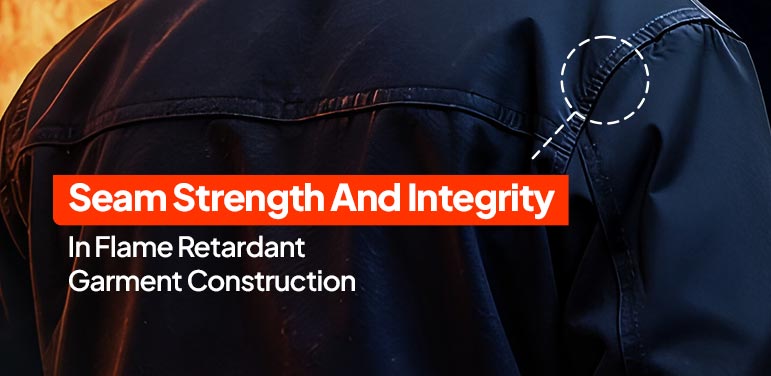
Safety is crucial in fire and heat exposure work areas. FR Garments made of flame-resistant (FR) fabrics provide essential protection, but the seams also play an important role. Workers in industries such as firefighting, oil and gas, and electrical utilities face significant risks from fire and heat exposure. In flame retardant (FR) garment construction, seam integrity is the critical factor that ensures the fabric’s protective properties are not compromised during exposure to fire or arc flash. Even if a fabric is highly flame-resistant, a failure in the sewing thread or seam structure can lead to “seam opening,” allowing heat penetration and direct skin exposure.
Safety Standards: Integrity In FR
FR Garments and fire retardant threads are most essential in protective gear, ensuring that all the components, including seams, meet safety standards. Seam is not just thread. It is a main structural component that must survive heat, flame, abrasion, and repetitive laundering while keeping seams intact. The requirement is not that the thread remains perfect after extreme exposure. It should avoid melting or dripping, maintain seam integrity and not become the first failure point.
Manufacturers must ensure garments comply with safety standards, such as NFPA 2112 (National Fire Protection Association), EN ISO 11612 (European Standard for Protective Clothing).
In accordance with EN ISO 11612 (Protective Clothing Against Heat and Flame), all certified performance characteristics, including mechanical and flame-resistant properties and shall be verified after the maximum manufacturer, recommended number of washing cycles, or A minimum of 5 laundering cycles, whichever is applicable. This ensures durability and sustained protective performance throughout the garment’s service life.
NFPA 2112 FR garments, Tested for heat resistance, should not melt.
For woven outer shell materials, seam strength shall be evaluated in accordance with ISO 13935-2 (Determination of Maximum Force to Seam Rupture). This ensures structural integrity under mechanical stress encountered during industrial use. The seam shall demonstrate a minimum breaking load of ≥ 300 N.
Seams shall maintain structural integrity when subjected to limited flame spread testing as per ISO 15025 (Clause A1 – Surface Ignition or Clause A2 – Edge Ignition).No seam rupture, opening, or structural failure shall occur during or after flame exposure. This requirement confirms that seam construction does not compromise flame protection performance.

Key Components Of Seam Integrity
Seam Thread Material
1. Meta-Aramid Threads – Heat & Flame Priority
Meta-aramid threads provide excellent thermal stability and inherent flame resistance. They do not melt and perform reliably under direct heat exposure.
2. Para-Aramid Threads – Strength under Load
Para-aramid threads offer very high tensile strength along with good heat resistance. They are ideal for high-stress seam applications.

Stitch And Seam Selection
Seam construction directly impacts garment durability, especially in protective wear.
1. Double / Triple Needle Stitching
Provides multiple stitch lines for load distribution and redundancy, reducing the risk of total seam failure.
2. Reinforced Stitching (Bar Tacks / Triangle Stitches)
Strengthens high-stress areas such as pockets, belt loops, and crotch points to prevent tearing under tension.
3. Flatlock Seams
Low-profile seams that reduce friction and improve comfort while maintaining strength.
4. Flat-Felled Seams
Enclosed, highly durable seams offering excellent strength and abrasion resistance for industrial applications.
Understanding Structural Seam Areas In Work-wear Design
- Main construction seams (body panels, sleeves, inseams)
- Reinforcement zones (shoulders, elbows, knees)
- Closure and edge areas (cuffs, collars, hems)
- Attachment seams for reflective tapes or layered parts (depending on system design)
Common Causes Of Seam Failure And Preventions
| Seam Failures | Causes Of Seam Failure | Prevention |
| Thread Mismatch | Using non-FR or incorrect count thread weakens the seam and may cause early rupture or melting. | Use inherent FR threads and validate seam strength as per ISO 13935-2. |
| Industrial Laundering | Frequent high-temperature washing and chemicals degrade weak threads over time. | Select wash-resistant FR threads and verify performance after washes as required by EN ISO 11612. |
| Mechanical Stress & Abrasion | Friction from movement or gear (e.g., harnesses) wears down seams at stress points. | Use reinforced stitching and stronger threads in load-bearing areas. |
| Seam Slippage / Grinning | Fabric yarns pull away from the seam edge, creating gaps even when stitches remain intact. This is common in lightweight or loosely woven fabrics due to incorrect thread tension or excessive stitch length. | Increase seam allowance and stitch density (higher SPI), use seam stabilization methods (French seams, stay tape, or interfacing), use differential feed to control fabric movement and verify seam slippage resistance as per ASTM D434. |
| Fabric Rupture | The fabric tears along the seam line due to excessive stress or unsuitable seam construction for the fabric weight. | Reinforce high-stress zones (crotch, armholes, pockets) using bar tacks or double stitching and ensure proper garment fit to avoid excessive load. |
Leave a Reply