
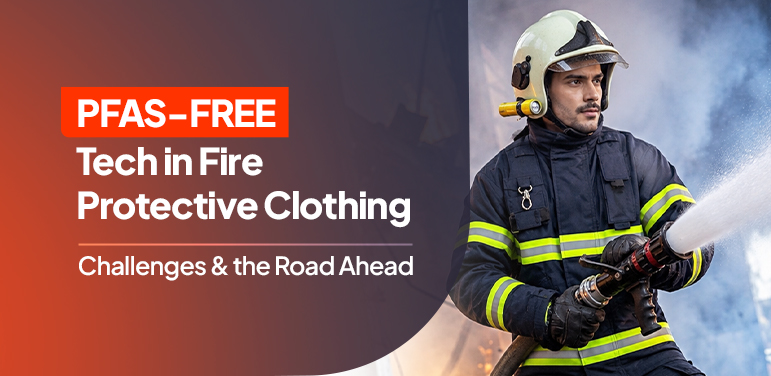
Fire protective clothing spans far more than the structural turnout gear worn by firefighters. The category includes wildland fire garments, industrial flame-resistant (FR) coveralls, station wear, and specialty gear used in aviation and petrochemical response. Across nearly all of these garment types, per and polyfluoroalkyl substances (PFAS) have historically been used to deliver water, oil, and chemical repellence most extensively in the outer shell, moisture barrier, and thermal liner of structural turnout gear. These “forever chemicals” made garments more durable and easier to clean, but that same chemical stability is now at the centre of a growing occupational health and environmental controversy.
As research linking PFAS to elevated cancer risk accumulates and state legislatures move to restrict its use, the fire protective clothing industry as a whole is racing to develop PFAS-free alternatives that do not compromise the safety of the people who wear this gear. Structural turnout gear has been studied and regulated most extensively so far, so it offers the clearest window into how the broader industry is approaching this transition.
Why is PFAS used in firefighters’ protective gear?
PFAS (Per- and Polyfluoroalkyl Substances) have been widely used in firefighters’ protective clothing because they provide critical performance characteristics required for firefighter safety.
| Property provided by PFAS | Why it is important for firefighters |
| Water repellence | Prevents water from penetrating the garment. Keeping the gear dry reduces heat transfer and helps prevent steam burns when firefighters are exposed to high temperatures. |
| Oil and chemical resistance | Repels oils, fuels, hydraulic fluids, and certain hazardous chemicals encountered during firefighting and rescue operations, reducing contamination of the protective clothing. |
| Moisture barrier performance | PFAS-based membranes provide a waterproof yet breathable barrier that prevents external liquids from entering while allowing sweat vapor to escape, helping reduce heat stress. |
| Compliance with safety standards | The water- and chemical-resistant properties of PFAS help turnout gear satisfy performance requirements in firefighter PPE standards, such as resistance to water penetration and liquid chemical exposure. |
| Durability | PFAS coatings maintain their protective properties even after repeated use, laundering, and exposure to harsh firefighting environments. |

Why PFAS Under Scrutiny Then?
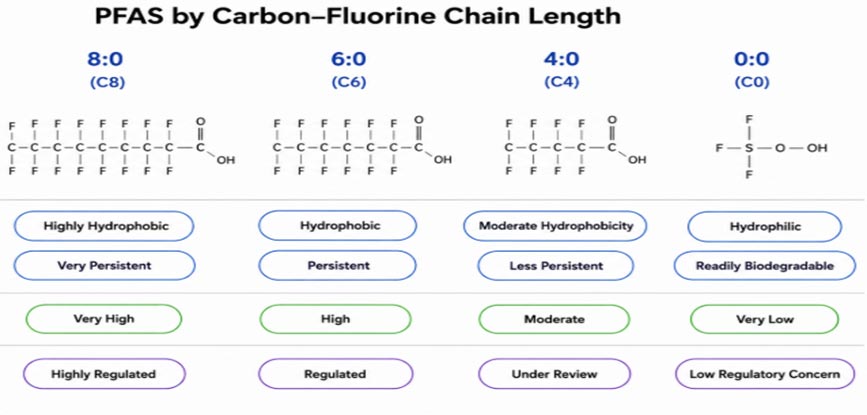
PFAS chemistries commonly known as C8, C6, and C0 were widely adopted in turnout gear because their strong carbon-fluorine bonds resist heat, chemicals, and moisture with unmatched durability. They were used as durable water repellent (DWR) finishes on outer shells.
That same chemical durability, however, means PFAS do not break down naturally and can accumulate in the body over time. That firefighter turnout gear textiles contain PFAS, and that wear, laundering, abrasion, and heat exposure can cause gear to release more of these compounds over its service life.
Peer-reviewed research has connected occupational PFAS exposure to elevated risks of several cancers, thyroid disease, and other health effects, compounding concerns for a profession that the National Institute for Occupational Safety and Health (NIOSH) has already linked to higher-than-average cancer incidence. The International Association of Fire Fighters (IAFF) and the Metropolitan Fire Chiefs Association have jointly called for the elimination of PFAS from turnout gear, describing it as an unnecessary occupational exposure on top of the hazards firefighters already face on the job.
How Much PFAS Is Still Allowed? Understanding C8, C6, C4, C0 and ppm Thresholds
Much of the confusion in the market comes from the fact that “PFAS-free” is not yet a single, uniformly enforced standard. The shorthand “C8”, and “C6”, and “C4”, refer to the length of the carbon chain in a fluorinated compound. C8 chemistries, associated with PFOA, were the first generation of durable water repellents used in protective textiles, most reputable suppliers phased them out roughly a decade ago because of their strong links to health harm. C6 chemistries, associated with PFHxA, were widely adopted as the “safer” replacement and are still used in a large share of gear sold today, but emerging research suggests short-chain C6 compounds may present nearly comparable risks, and regulators are increasingly treating them the same way.
Because a garment can contain many different PFAS compounds, most regulations and test methods do not chase each one individually. Instead, they measure Total Organic Fluorine (TOF) or total fluorine as a proxy for overall PFAS content, expressed in parts per million (ppm). In its most recent update, the European Chemicals Agency (ECHA) added “technical textiles” as one of the additional sectors under review, a category that includes protective and industrial workwear alongside structural turnout gear.
| Jurisdiction / Standard | Current or Proposed Threshold | Effective Timing |
| U.S. state apparel PFAS laws | 100 ppm total organic fluorine, tightening to 50 ppm | 100 ppm from 2025; 50 ppm by 2027 |
| EU REACH – PFHxA (C6) restriction | Concentration limits on PFHxA and related C6 substances in textiles, footwear and apparel | Enters into force October 2026 |
| Denmark (national) | Total fluorine ≥ 50 mg F/kg in clothing, footwear and waterproofing agents | Already in force |
Engineering a PFAS-Free Turnout Gear System
Replacing PFAS is not a one-ingredient swap. Each of the three functional layers in turnout gear has historically depended on fluoro-chemistry for a different job, so manufacturers have had to re-engineer the system layer by layer.
| Layer | Traditional Approach | PFAS-Free technology Direction |
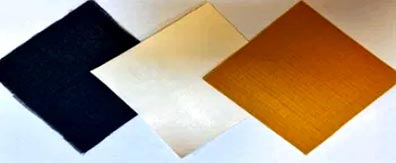
| Outer Shell | Fluoropolymer/fluorocarbon durable water repellent (DWR) finishes | Non-fluorinated DWR chemistries, silicone- and wax-based repellents, engineered aramid weaves |
| Moisture Barrier | PTFE (ePTFE) membranes and fluorinated laminates for liquid and pathogen protection | Non-fluorinated, non-halogenated membranes such as Milliken’s Assure barrier
 UL-certified flame-resistant moisture barrier |
| Thermal Liner | FR battings sometimes finished with fluorochemical treatments | Non-PFAS FR fibre blends with comparable thermal insulation and loft |
The moisture barrier has proven to be the hardest layer to reformulate, since it must simultaneously block liquids and bloodborne pathogens, remain breathable, and withstand years of flexing, heat, and laundering. That gap persisted in the market until October 2024, when Milliken introduced Assure described as North America’s first non-halogenated, non-PFAS flame-resistant moisture barrier. Its arrival allowed manufacturers such as Fire-Dex to offer a fully non-PFAS three-layer ensemble certified to NFPA 1971-2018 and the newer NFPA 1970-2025 standard.
Current Challenges in Market
- Fragmented thresholds: Manufacturers selling across U.S. states, the EU, and other markets face a patchwork of ppm limits, banned-chemical lists, and labelling rules rather than one harmonized standard, which pushes suppliers toward building jurisdiction-by-jurisdiction compliance matrices.
- Limited oil repellency: PFAS-free DWR finishes (silicone, hydrocarbon, or wax-based) provide good water repellency but inferior oil and chemical repellency compared to fluorinated finishes.
- Moisture barrier performance: PFAS-free membrane alternatives (PU, polyester, TPO) often have lower heat resistance, breathability, and long-term durability than PTFE-based membranes. Some PFAS-free finishes show decreased performance after repeated laundering, abrasion, UV exposure, and harsh firefighting conditions.
- Certification challenges: Alternative materials must be requalified to meet stringent firefighter PPE standards (e.g., EN 469, NFPA 1970), increasing development time and cost.
- Limited long-term validation: Insufficient field-performance data are available to fully assess service life and reliability under operational firefighting conditions.
- Higher manufacturing cost: Development of new membrane technologies and finishing systems increases production costs, resulting in higher garment prices.
- Supply chain constraints: Commercial availability of certified PFAS-free membranes and high-performance finishes remains limited compared to conventional PFAS-based materials.
- Performance trade-offs: Achieving an optimal balance between waterproofness, breathability, thermal protection, chemical resistance, and comfort without PFAS remains a major technical challenge.
- Market transition: Manufacturers must invest in new formulations, process modifications, and certification testing while complying with evolving PFAS regulations.
- Uneven progress outside structural firefighting: Regulatory pressure has concentrated on firefighter turnout gear first, general industrial FR workwear, welding gear, and hi-vis clothing are earlier in the transition, with PFAS-free finishing chemistries only recently reaching commercial scale for those categories.
The Road Ahead for PFAS-Free Fire Protective Clothing
The direction of the industry is now fairly clear, even if the pace varies by department, employer, and jurisdiction. With NFPA 1970-2025 formalizing restricted-substance testing, multiple states legislating firm phase-out deadlines. For an industry built around protecting people from harm, closing the gap between PFAS-free garments and legacy performance is becoming as much a safety priority as flame resistance itself. Several countries are highly investing in this:
- San Francisco Fire Department ran a 90-day wear trial with 50 firefighters during live-fire training before committing to roughly 1,100 PFAS-free ensemble sets, funded in part by a $2.35 million FEMA grant and was UL-certified, meeting both NFPA 1971-2018 and the newer NFPA 1971-2025 standards.
- East Providence, Rhode Island became the first U.S. department to adopt non-PFAS turnout gear department-wide, a $658,000 investment covering all three gear layers.
- Vancouver Fire Rescue Services in Canada approved a one-time budget increase of roughly $2.8 million in 2024 to procure non-PFAS bunker gear for its personnel, making it among the first major departments worldwide to transition fully to non-PFAS coats and pants.
Development of next-generation PFAS-free moisture barriers with improved waterproofness, breathability, heat resistance, and durability to replace PTFE-based membranes remains the highest R&D priority. Advanced non-fluorinated DWR technologies, including silicone-based polymers, plasma surface treatments, sol-gel coatings, and bio-based hydrophobic finishes, are expected to become more widely commercialized as performance improves. Increased investment in research and collaborative development by governments, research institutes, fibre producers, membrane manufacturers, and PPE companies is accelerating the commercialization of PFAS-free solutions. The proposed Protecting Firefighters and Advancing State-of-the-Art PFAS Alternatives Act in the U.S. is intended to support this transition.
More stringent regulations and certification requirements (e.g., NFPA 1970 Restricted Substances List and evolving EU PFAS restrictions) will drive manufacturers toward safer materials and greater chemical transparency. Independent chemical verification and third-party certification (e.g., OEKO-TEX® and restricted substance testing) are expected to become standard purchasing requirements to validate PFAS-free claims. Long-term field validation through wear trials, laundering studies, contamination testing, and firefighter feedback will be essential before widespread adoption of new PFAS-free technologies.
Leave a Reply