
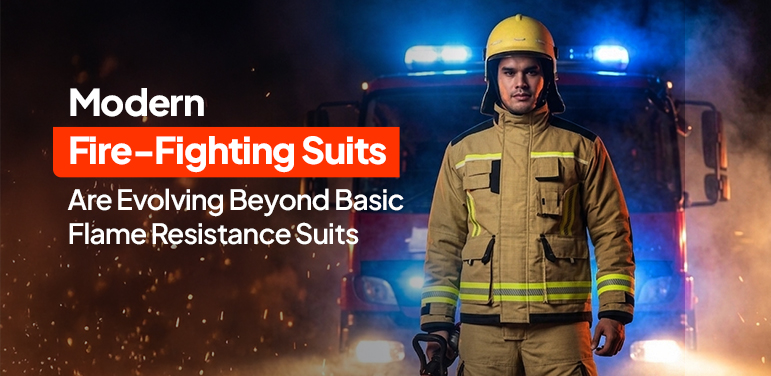
Firefighting has evolved significantly over the last few decades. Today’s firefighters are not only exposed to open flames but also to extreme radiant heat, toxic combustion products, carcinogenic particulates, flashover conditions, hazardous chemicals, structural collapse risks and physiological stress caused by prolonged exposure to high-temperature environments.
As operational risks have become more complex, protective clothing has undergone a similar transformation. Modern fire-fighting suits are no longer designed solely to resist ignition or prevent flame spread. Instead, they are engineered as integrated protective systems that combine advanced flame-resistant fibres, thermal insulation technologies, moisture barriers, ergonomic design, physiological monitoring, and digital connectivity.
The focus has shifted from basic flame protection toward optimizing thermal protective performance, reducing heat stress, improving mobility, and enhancing firefighter survivability during emergency response operations.
From Traditional Turnout Gear to Advanced Protective Systems
Historically, firefighter garments relied on heavy wool fabrics and limited heat-resistant materials. While these systems provided some protection against heat exposure, they often restricted movement and offered limited resistance to thermal penetration.
The introduction of inherently flame-resistant fibres transformed firefighter PPE. Unlike chemically treated fabrics whose performance may diminish over time, inherently flame-resistant fibres possess permanent flame-resistant properties embedded within their molecular structure.
Modern structural firefighting ensembles are now designed to comply with internationally recognized standards such as:
- NFPA 2112 (US standard National Fire Protection Association)
- EN 469 (European standard- Protective Clothing for Firefighters)
- EN 1486 (Fire Proximity Clothing)
- ISO 15384 and ISO 16073 (Wildland Firefighting)
- ISO 11612 (Protection against Heat and Flame)
- ISO 13506 (Thermal Manikin Testing)
These standards evaluate thermal insulation, flame resistance, moisture penetration, mechanical durability, visibility, and physiological comfort.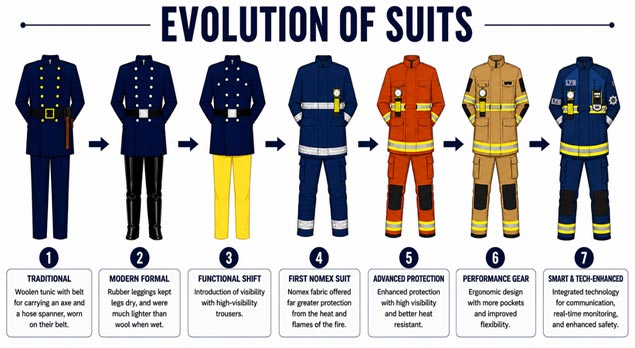
Advanced Fibers Driving Next-Generation Firefighter Protection
The performance of firefighter protective clothing begins at the fibre level. Several advanced fibre systems are currently used to optimize protection:
| Fiber Type | Primary Function |
|---|---|
| Meta-Aramid | Inherent flame resistance |
| Para-Aramid | Strength and abrasion resistance |
| PBI | Thermal stability and char formation |
| PBO | Extreme heat resistance |
| FR Viscose | Moisture management and comfort |
| Modacrylic FR | Self-extinguishing properties |
| Glass Fiber | Thermal reinforcement |
| Carbon Fiber | Excellent thermal stability, low heat shrinkage, antistatic performance |
Among these, PBO and PBI fibres are gaining increasing attention due to their exceptional thermal stability and minimal degradation under prolonged heat exposure, making them ideal for fire-fighting suits designed for extreme conditions.
These materials are often combined through engineered yarn constructions and multi-fibre blends to achieve the desired balance between protection, durability, flexibility and comfort in modern fire-fighting suits.
Next Generation- Thermal Management in Modern Suits
Heat stress remains one of the most significant health risks facing firefighters. To address this challenge, researchers and manufacturers are developing advanced thermal management technologies such as:
Phase Change Materials (PCM)
Microencapsulated PCM systems absorb and release thermal energy during temperature fluctuations, helping delay increases in core body temperature.
3D Spacer Textile Technologies
Spacer fabrics create controlled air layers that improve insulation while promoting airflow and moisture transport.
Lightweight Thermal Barrier Systems
Advanced fibre engineering allows thermal barriers to maintain protection while reducing garment bulk and physiological burden.
These innovations support longer operational durations while reducing the risk of heat-related injury.
Sustainability Driving Next-Generation PPE
Environmental considerations are increasingly influencing firefighter PPE development. Key innovations include:
- PFAS-free moisture barriers
- Non-fluorinated durable water-repellent (DWR) finishes
- Recyclable protective textile systems
- Low-impact manufacturing technologies
- Sustainable and bio-based fibre solutions
The industry’s focus is to achieve superior protection, durability, and comfort while reducing environmental impact across the product lifecycle.
Smart Firefighter PPE: Integrating AI, IoT, and Wearable Technologies
Perhaps the most significant transformation occurring within firefighter PPE is the integration of digital technologies.
Physiological Monitoring
Flexible sensors embedded within protective garments can monitor:
- Heart rate & Physical exertion levels
- Respiration rate
- Skin temperature & Core body temperature trends
Environmental Monitoring
Integrated sensor systems are being developed to detect:
- Carbon monoxide
- Oxygen deficiency
- Hazardous gases
- Ambient temperature extremes
AI-Assisted Safety Analytics
Emerging AI platforms can analyse physiological and environmental data to identify:
- Heat stress risks
- Fatigue indicators & Emergency intervention requirements
- Exposure trends
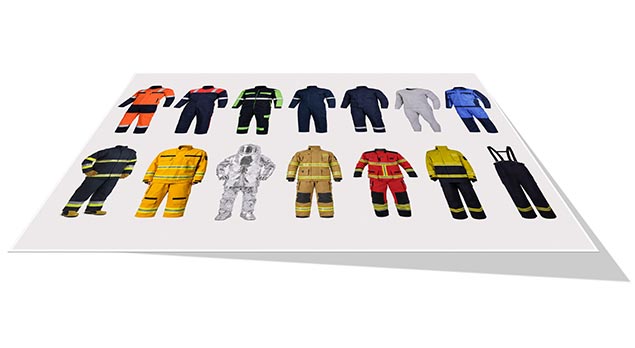
Specialized Protective Systems for High-Risk Operations
Firefighting PPE is engineered according to specific operational hazards.
Structural Firefighting Suits
- Multi-layer thermal protection systems
- Flame and particulate resistance
- High mechanical durability
IoT-Enabled Connectivity
Connected PPE systems can transmit real-time information to incident command centres through wireless communication networks. This allows improved monitoring of firefighter safety and operational status.
Wildland Firefighting Garments
- Lightweight, breathable constructions
- Heat-stress reduction
- Enhanced mobility for extended deployments
Fire Proximity Suits
Used in extreme radiant heat environments such as aircraft rescue, petrochemical plants, foundries, industrial furnaces, these advanced materials are widely used in fire-fighting suits for enhanced protection. These systems typically incorporate aluminized outer shells with aramid or glass-fibre-based substrates to maximize radiant heat reflection and thermal protection, ensuring fire-fighting suits perform reliably in high-temperature and hazardous environments.
Conclusion
Modern fire-fighting suits have evolved beyond basic flame protection into advanced protective systems that enhance safety, comfort, and performance. Innovations in flame-resistant fibres, multi-layer constructions, sustainable barrier technologies, thermal management, and smart monitoring are helping firefighters operate more safely in increasingly challenging environments. As AI, IoT, and wearable sensor technologies continue to advance, the next generation of firefighter PPE will deliver greater protection, real-time situational awareness, and improved physiological safety.
Leave a Reply