
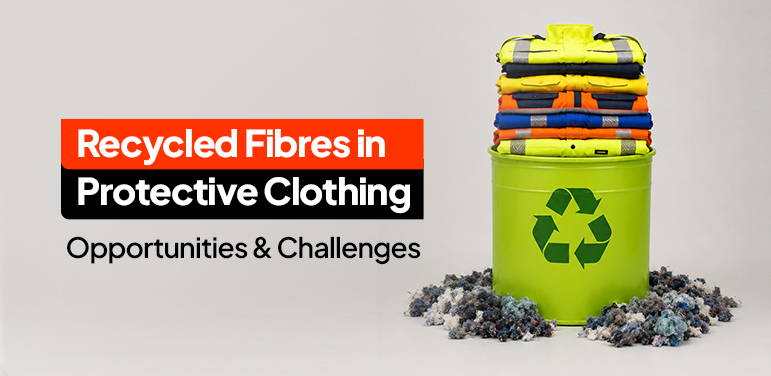
Sustainability is reshaping the protective textile industry, driving manufacturers to adopt circular solutions without compromising safety or regulatory compliance. As demand for environmentally responsible PPE grows, recycled fibres are emerging as a viable alternative to virgin raw materials, offering opportunities to reduce textile waste, lower carbon emissions, and improve resource efficiency.
Protective clothing has traditionally been manufactured using high-performance fibres such as aramids, modacrylics, flame-retardant viscose, and wool, etc. While these materials deliver excellent thermal and mechanical protection, the disposal of end-of-life protective garments presents significant environmental and economic challenges. Recycling these valuable fibres enables their reintegration into new protective textiles, supporting a circular manufacturing approach while conserving critical resources.
However, recycling protective textiles is considerably more complex than conventional textile recycling. Maintaining flame resistance, mechanical integrity, durability, and compliance with international safety standards requires advanced recycling technologies, optimized fibre blending, and stringent quality control.
Recycled Fibres in Protective Clothing: A Sustainable Approach to Resource Optimization
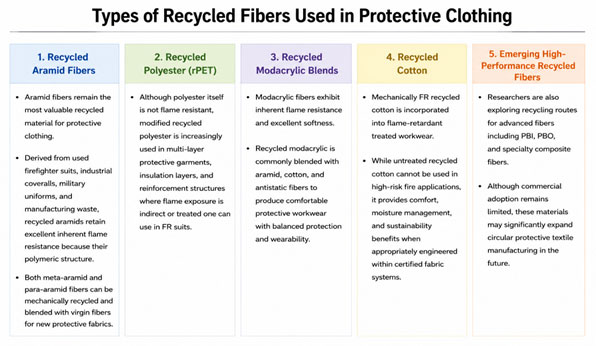
Protective FR clothing incorporates high-value technical fibres engineered to withstand extreme thermal, mechanical, and electrical hazards throughout their service life. Even after retirement, many of these fibres retain a significant portion of their inherent performance characteristics, making them suitable for recovery and reprocessing into new textile products.
Unlike conventional apparel, protective garments represent a substantial investment in advanced materials such as aramids and other inherently flame-resistant fibres. Recovering these fibres extends their material lifecycle, improves resource utilization and reduces dependence on newly manufactured technical fibres. This approach aligns with circular manufacturing principles by maximizing the value extracted from existing materials before disposal.
Recycling high-performance fibres delivers both environmental and economic value by extending the lifecycle of engineered materials used in protective FR clothing. It reduces textile waste, decreases reliance on virgin synthetic fibres, conserves petrochemical resources, and lowers the carbon footprint associated with fibre production. Advances in mechanical recycling, fibre recovery, and optimized blending technologies have further enabled recycled technical fibres to be incorporated into protective textiles while maintaining the performance required for industrial applications. As a result, end-of-life protective garments are increasingly being recognized as a valuable secondary raw material, supporting circular manufacturing, efficient resource utilization, and long-term sustainability within the PPE industry.
Recycling Technologies and Process
Recycling high-performance fibres used in protective clothing requires specialized processing to preserve their thermal, mechanical, and flame-resistant properties. Depending on the fibre type and desired material quality, two primary recycling approaches are adopted within the textile industry.
Mechanical Recycling
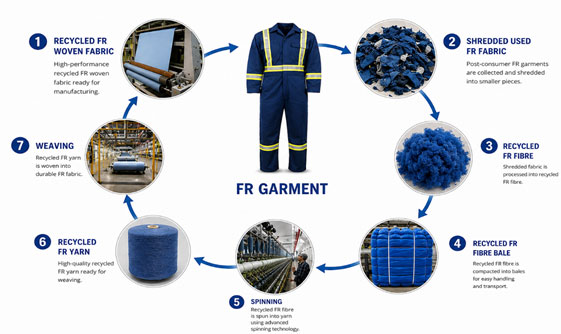
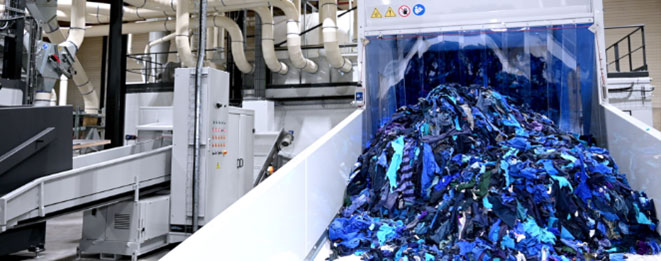
Mechanical recycling is currently the most mature and commercially adopted process for protective textiles. The process begins with the collection and sorting of end-of-life garments based on fibre composition, colour, and contamination level. Components such as zippers, buttons, reflective tapes, and trims are removed before the garments are shredded into individual fibres
Since shredding reduces fibre length and strength, the recovered fibres are typically blended with virgin fibres to restore spinnability and mechanical performance. The blended fibres are then carded, spun into yarns, converted into woven or knitted fabrics, and finally manufactured into new protective clothing. Owing to its scalability and cost-effectiveness, mechanical recycling remains the preferred route for recycling flame-resistant garments.
Chemical Recycling
Chemical recycling involves depolymerizing textile polymers into their molecular building blocks, which are subsequently purified and regenerated into new fibres. This process has the potential to produce recycled fibres with properties comparable to virgin materials while removing contaminants and impurities. However, due to the complex chemistry of high-performance fibres such as aramids, along with high processing costs and limited commercial infrastructure, chemical recycling is still in the developmental stage for most protective textile applications. Nevertheless, continued advancements in polymer recovery technologies are expected to enhance its industrial feasibility in the future.
Global Recycled Standard (GRS): Ensuring Traceability and Sustainability
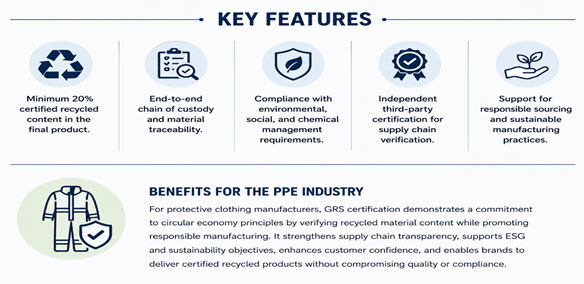
The Global Recycled Standard (GRS) is an internationally recognized voluntary certification developed by Textile Exchange to verify recycled material content throughout the entire supply chain. Applicable to products containing at least 20% recycled material, GRS covers every stage of production from recycling and manufacturing to packaging, labelling, trading, and distribution.
Beyond verifying recycled content, GRS establishes strict requirements for chain of custody, environmental management, responsible chemical use, and social compliance, ensuring that recycled products are manufactured under sustainable and ethical conditions. Certification provides complete material traceability and enhances supply chain transparency.
Opportunities And Technical Challenges
Opportunities
The integration of recycled fibres into flame-resistant clothing offers substantial opportunities across the textile value chain.
From an environmental perspective, recycled fibres reduce carbon emissions, conserve petroleum-based raw materials, and divert valuable textile waste from landfill disposal. Lifecycle assessments have demonstrated measurable reductions in greenhouse gas emissions when recycled aramid fibres partially replace virgin materials.
Economically, recycling allows manufacturers to recover high-value engineering fibres that would otherwise become waste. Considering the high production cost of aramid fibres, even partial material recovery represents significant resource savings.
Recycled fibres also strengthen supply chain resilience. Global disruptions have demonstrated the vulnerability of raw material sourcing. Developing closed-loop recycling systems enables manufacturers to reduce dependence on virgin fibre production while improving long-term material security.
Customer expectations are evolving as well. Industrial buyers increasingly prioritize suppliers capable of demonstrating sustainability performance alongside product certification. Offering recycled-content PPE allows manufacturers of flame-resistant clothing to differentiate themselves in an increasingly competitive marketplace while supporting customers’ ESG commitments.
Furthermore, government regulations promoting circular economy initiatives are expected to create additional market incentives for textile recycling, accelerating investment in recycling infrastructure and sustainable product development.
Technical Challenges
Despite significant progress, recycling protective textiles presents several technical challenges that distinguish it from conventional textile recycling. The most immediate issue is contamination. Used protective garments may contain oils, hydrocarbons, combustion residues, hazardous chemicals, or PFAS-based water-repellent finishes. Effective decontamination is essential before recycling can safely begin.
Mechanical shredding introduces another challenge by shortening fibre length. Reduced fibre length affects yarn strength, spinning efficiency, abrasion resistance, and overall fabric durability. Manufacturers therefore carefully optimize recycled-to-virgin fibre ratios to maintain performance. Colour consistency also becomes increasingly difficult when recycled fibres originate from garments with different dye histories. Residual coloration may restrict achievable shade ranges or require advanced dyeing strategies.
Material compatibility presents another engineering consideration. Protective fabrics often contain multiple fibre types including aramid, modacrylic, antistatic fibres, nylon, and elastane. Each material responds differently to mechanical processing and dyeing conditions, complicating manufacturing operations. Perhaps the greatest challenge is regulatory compliance. Protective garments must continue meeting international standards governing flame resistance, arc protection, thermal insulation, mechanical performance, and durability after repeated laundering. Manufacturers must therefore validate recycled-content fabrics through extensive laboratory testing before commercial deployment.
Balancing sustainability, performance, comfort, and production cost remains one of the industry’s most demanding engineering tasks.
Industrial Adoption and Future Outlook
The adoption of recycled fibres is expanding across multiple protective clothing applications, including firefighter turnout gear, industrial FR workwear, arc-rated garments, military uniforms, and protective gloves. Recycled technical fibres are also finding applications in nonwovens, insulation materials, filtration media, and composite reinforcements, demonstrating their versatility beyond conventional apparel.
Continued advancements in fibre recovery, automated sorting, contamination removal, and recycling technologies are improving the quality and performance of recycled materials. Combined with growing emphasis on circular economy practices, lifecycle assessment, and stricter environmental regulations, these innovations are accelerating the development of sustainable protective textiles.
Although technical challenges remain, ongoing collaboration between fibre manufacturers, textile producers, research organizations, and PPE manufacturers is driving the commercialization of recycled high-performance fibres. As recycling technologies mature, recycled-content protective clothing is expected to play a significant role in delivering sustainable, high-performance PPE while reducing environmental impact and promoting efficient resource utilization.
Leave a Reply