
High-visibility protective clothing is not simply a garment made from fluorescent fabric with reflective tape. It is an engineered visibility system designed to make the wearer conspicuous against complex backgrounds, during daylight, low-light and night-time conditions and in higher-risk industries, while simultaneously providing protection against flame, heat, arc flash, chemicals or other hazards.
For workers operating around moving vehicles, heavy equipment, rail infrastructure, offshore facilities, construction sites and industrial plants, visibility is a risk-control function. The effectiveness of the garment depends not only on the colour of the fabric, but also on fluorescent area, retroreflective performance, material placement, garment geometry, contrast, movement and durability.
Core Science and What Makes a Garment “High-Visibility”?
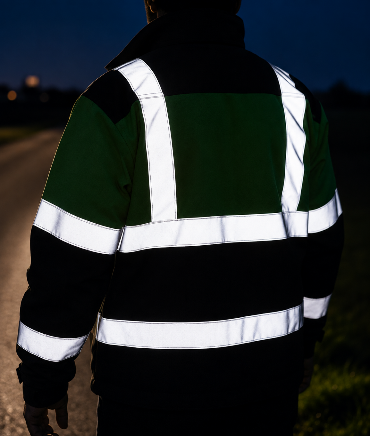
ISO 20471 defines requirements for high-visibility clothing intended to signal the wearer’s presence to operators of vehicles and mechanised equipment during daylight and under headlight illumination in darkness. The standard addresses three major design parameters:
- Colour performance
- Retroreflective performance
- Minimum visible areas and material placement
This is important because visibility is not achieved simply by selecting a bright fabric. The complete garment must create sufficient visual contrast and maintain that contrast in the intended working environment.
Hi-vis performance rests on two distinct optical mechanisms that address two different lighting conditions, plus a third category that combines them.
- Fluorescence (daytime and low light): Fluorescent pigments absorb ultraviolet energy from sunlight — including on overcast days and re-emit it as visible light at a longer wavelength. This makes the fabric appear brighter than its true reflected colour would allow, which is why fluorescent yellow-green, orange-red, and red outperform ordinary bright fabrics at dawn, dusk, and in overcast conditions. Fluorescence requires a natural UV source and is not effective at night.
- Retroreflection (night and artificial light): Retroreflective material is engineered to return incident light back toward its source rather than scattering it. Retroreflective material contributes little in bright daylight, since there is minimal contrast between the light it returns and ambient light already in the scene.
- Combined-performance material: A retroreflective material that is also fluorescent, giving a single garment both a daytime brightness advantage and a nighttime retroreflective advantage. Not all retroreflective materials are fluorescent, and not all fluorescent materials are retroreflective — combined-performance material has to be engineered and tested as its own category.
Governing Standards: What Actually Gets Tested
Regulatory bodies do not certify a garment as “high-visibility” based on appearance. Standards define minimum background and retroreflective surface areas, required chromaticity (colour) coordinates, minimum luminance factor, stripe width and placement, and performance retention after laundering and UV exposure.
The major global standards are EN ISO 20471 (Europe), ANSI/ISEA 107 (United States), and AS/NZS 1906.4 / 4602.1 (Australia and New Zealand), Canada’s CSA Z96 sets similar requirements based on body-coverage percentage rather than fixed minimum areas. Garment technical documentation from TARASAFE which certifies its Limelite FR Coverall and related hi-vis ranges against several of these standards concurrently, illustrates how the numeric thresholds compare in practice.
| Class | Background Material (min.) | Retroreflective Material (min.) | Combined-Performance Material |
| Class 1 | 0.14 m² | 0.10 m² | 0.20 m² |
| Class 2 | 0.50 m² | 0.13 m² | — |
| Class 3 | 0.80 m² | 0.20 m² | — |
EN ISO 20471 (Class 1–3) shown above; ANSI/ISEA 107-2020 uses a parallel but differently structured system based on garment Type (O, R, or P) and Class, measured in square inches rather than square meters:
| Garment Type / Class | Background Material (min.) | Retroreflective Material (min.) | Typical Use |
| Type O, Class 1 | 217 in² | 155 in² | Off-road, non-roadway sites |
| Type R, Class 2 | 775 in² | 201 in² | Roadway traffic exposure |
| Type R, Class 3 | 1,240 in² | 310 in² | High-speed / low-visibility roadway |
| Type P, Class 2/3 | 450 / 775 in² | 201 / 310 in² | Fire, police, EMS personnel |
Where Hi-Vis Performance Meets Other Hazards
A meaningful share of the industrial and utility workforce needs visibility performance layered onto flame, arc, or chemical protection. A vest alone does not address that combination. This is an engineering problem, not just a colouring one; fluorescent pigments and retroreflective tape adhesives have to survive the same certification testing (flame exposure, arc rating, laundering cycles) as the base FR fabric without degrading either property.
For industries such as oil & gas, petrochemicals, electrical utilities, welding, offshore operations and emergency response, visibility is rarely the only hazard. For multi-risk FR garments, reflective tape should be considered a functional component of the protective system.
The garment may simultaneously require:
High Visibility + Flame Resistance + Arc Protection + Antistatic Performance + Chemical Protection + Mechanical Durability
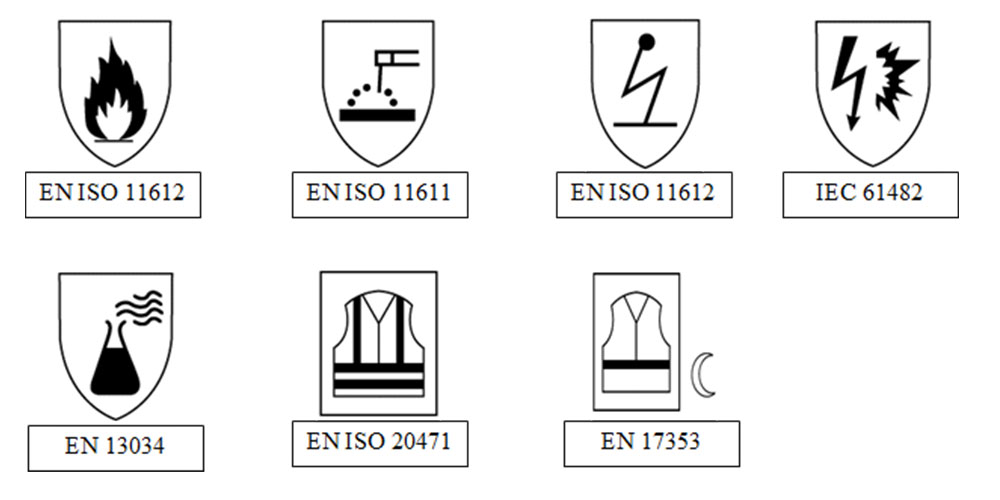
TARASAFE’s technical documentation shows this in practice, garments in its Limelite range are simultaneously certified to EN ISO 11612 (heat and flame), EN ISO 11611 (welding), IEC 61482 (arc flash, with Arc Protection Class and specific ATPV/ELIM cal/cm² values reported per fabric), EN 1149-5 (antistatic), EN 13034 (limited chemical splash), and EN ISO 20471 (high visibility) in a single certified garment. That layering is the practical difference between apparel that is merely coloured for visibility and PPE engineered to remain both visible and protective in a specific hazard environment.
Durability: The Property That Degrades Silently
Hi-vis performance is not permanent, and unlike a torn seam, its loss is not always visually obvious to the wearer. Retroreflective tape can crack, peel, or lose adhesion with repeated flexing and laundering, fluorescent pigments fade under sustained UV exposure and heavy soiling or contamination reduces both luminance factor and retroreflective return, even when the garment still looks intact from a distance.
Occupational health guidance is explicit that contaminated or degraded retroreflective material provides measurably lower visibility and recommends replacing garments showing wear, soiling, or damage rather than relying on visual inspection alone to judge remaining performance. Manufacturer wash-care instructions and rated wash-cycle counts documented per fabric on certified hi-vis products.
Design Requirements That Affect Real-World Detection
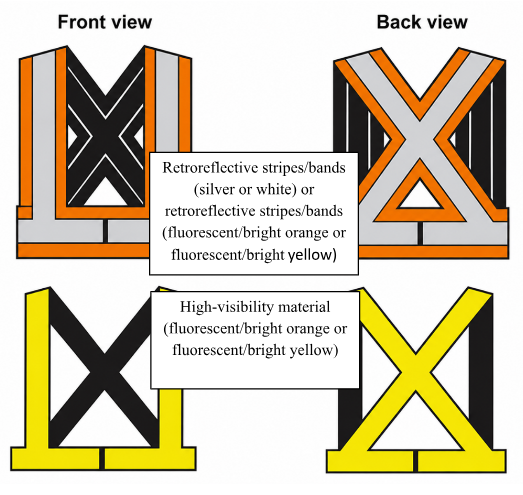
360° coverage: Standards require visibility from all sides, not just the front, since a worker’s orientation relative to an approaching vehicle changes constantly.
Minimum stripe width and placement: A horizontal band at waist level plus vertical bands over the shoulders (and, for higher classes, bands encircling the arms and legs) are specified so the human silhouette is recognizable at a glance, this pattern recognition matters as much as raw brightness for fast detection.
Unobstructed material: Backpacks, tool belts, high-cut boots, or other equipment that covers required hi-vis area can reduce a garment below its certified class in practice, even though the garment itself is compliant on the hanger.
Fit and layering: Because coverage requirements assume the garment is worn over or under other clothing as intended, a hi-vis garment that is undersized, oversized, or worn open no longer delivers its certified area of visible material.
Selection Guidance of High-Visibility FR Clothing
- Match class to hazard exposure, not budget: Higher classes (EN ISO 20471 Class 3; ANSI/ISEA Type R Class 3) are appropriate wherever vehicle speeds, task-related distraction, or low-light hours increase detection risk — downgrading class to save cost shifts risk onto the worker.
- Treat retroreflective and fluorescent performance as separate specifications: A garment strong in daytime fluorescence is not automatically adequate for night work, and vice versa confirm both properties are certified for the actual working hours.
- For multi-hazard environments, specify concurrently certified garments: A hi-vis vest layered over FR or arc flash protective clothing is not equivalent to a single garment independently certified to both EN ISO
Leave a Reply