
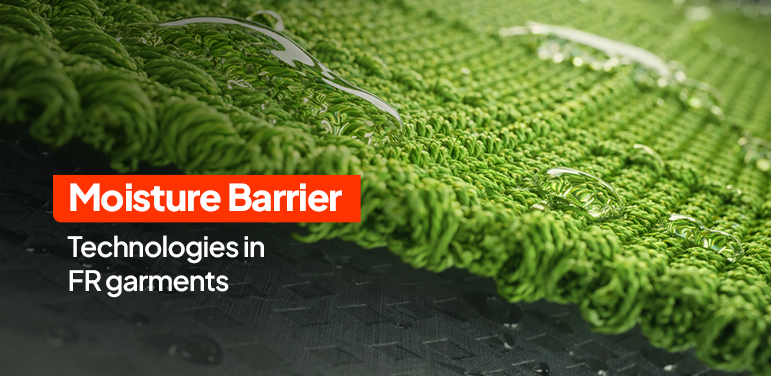
Firefighters and industrial personnel exposed to flash fire or steam hazards depend on multilayer protective systems that provide thermal insulation, liquid resistance, and breathability. Among these layers, the moisture barrier is crucial- it ensures protection against external liquids while maintaining internal comfort through controlled vapour permeability – Moisture Barrier Technologies.
Functional Role of the Moisture Barrier:
A moisture barrier is the intermediate layer positioned between the outer shell and the thermal liner of a turnout suit.
It performs two essential functions:
- Blocks external liquids such as water, steam, chemicals, or body fluids.
- Permits moisture vapour transmission from perspiration, helping regulate the wearer’s microclimate.
By preventing both external wetting and internal condensation, the barrier minimizes steam burns, maintains thermal insulation stability, and enhances overall comfort during intense firefighting or industrial operations.
Layer Configuration in Firefighting Garments:
- Outer Shell: Provides primary flame, heat, and abrasion resistance
- Moisture Barrier: Ensures waterproofness and vapour breathability
- Thermal Liner: Delivers insulation and wearer comfort by trapping air
Material Technologies for Moisture Barriers:
Modern moisture barriers are laminated composites that couple a membrane or film with an aramid substrate for mechanical strength and flexibility. Common technologies include-
- PTFE-Based Laminates (e.g., GORE-TEX®, Crosstech®): Expanded PTFE membranes with microporous structure-allowing vapour escape but resisting liquid and pathogen ingress. Exhibit excellent thermal and hydrolytic stability
- PU (Polyurethane) Membranes: Offer good waterproofness and elasticity, suitable for moderate-heat environments, though slightly less stable under prolonged thermal exposure.
Understanding MVTR (Moisture Vapor Transmission Rate)
MVTR measures how effectively a fabric or laminate allows water vapour to pass through, indicating its breathability
It is expressed as grams of water vapour transmitted per square meter in 24 hours (g/m²/24 h).
Higher MVTR – Better vapour permeability – Lower risk of heat stress.
Typical Test Method:
ISO 11092 (Ret Value): Inverse measure of breathability, lower Ret = higher MVTR.
In firefighting PPE, maintaining high MVTR helps prevent heat build-up while the barrier’s hydrostatic resistance ensures protection against external moisture- achieving both comfort and safety.
EN 343: Protection against Rain and Water Penetration
In addition to flame and heat resistance, moisture barrier laminates often undergo EN 343 testing, which assesses waterproofness and breathability for garments exposed to wet environments.
EN 343 Key Performance Parameters- Moisture Barrier Technologies:
- Water Penetration Resistance (Classes 1–4): Measures waterproofness under hydrostatic pressure (ISO 811). Class 4 = highest resistance (≥ 20 kPa)
- Water Vapour Resistance (Classes 1–4): Determined via Ret (ISO 11092); lower Ret means higher breathability
- Rain Tower Test (Optional): Simulates rainfall on a moving mannequin to evaluate full-garment sealing and construction
Relevance- Moisture Barrier Technologies
EN 343 compliance ensures the moisture barrier provides hydrostatic stability, seam sealing, and balanced breathability, making it suitable for flash fire and rescue operations where exposure to steam or water spray is common.
Performance Evaluation Parameters- Moisture Barrier Technologies:
When developing or selecting moisture barriers for FR clothing, the following parameters are typically validated:
- Hydrostatic Head / Water Resistance (ISO 811)
- Moisture Vapour Transmission (ASTM E96 / ISO 11092)
- Thermal Protective Performance (TPP)
- Seam Strength and Flex Durability
- Resistance to Chemicals and Pathogens (ASTM F903 / F1671)
- Thermal Shrinkage and Aging Behaviour
Tarasafe Product Range for Flash Fire and Structural Firefighting Protection
At Tarasafe, advanced multi-layer protective garments are engineered using certified moisture barrier systems and high-performance FR fabrics to meet global standards:
- Tarain CVC 290 PU: A durable cotton–polyester blend with PU coating, designed for waterproof and breathable FR Workwear applications.
- Taramod MACINCO 250 PU: Modacrylic–cotton blend laminated with PU, offering an excellent balance of flame resistance, flexibility, and moisture protection.
- Tarain Soft Shell 290: FR Polyester based comfortable, windproof, and water-resistant soft-shell construction providing superior breathability for moderate-risk environments.
- Tarain PA 240 PU: FR Polyester based PU-laminated fabric combining high tensile strength, low weight, and robust liquid protection properties.
These fabrics are tailored for structural firefighting suits, flash fire garments, and industrial FR Workwear, ensuring compliance with EN 343 and related global standards.
Conclusion- Moisture Barrier Technologies:
The evolution of moisture barrier technology has transformed firefighter and industrial protective clothing-from heavy, impermeable layers to lightweight, breathable, and highly protective composites. By optimizing MVTR, hydrostatic performance, and EN 343 compliance, today’s FR garments deliver superior thermal protection, physiological comfort and protection from rain.
Through continued innovation and stringent material engineering, Tarasafe remains committed to advancing next-generation moisture barrier systems that redefine comfort and safety in flash fire protection.
Leave a Reply